
✍️ Mohan Tigela
Language is not merely a medium of communication. It is identity, memory, history, and the soul of a people. When a language is given official recognition, it is not just a law that is passed a community finally finds its voice in the state.
That is what happened in Koshi Province.
The Government of Koshi Province has taken a truly historic step by enacting an Act in addition to the Nepali Language Act, publishing in the Gazette and formally implementing 13 languages — including Yakthung Limbu and Maithili — as languages for official government work in Province No. 1.
This was not a gift. It was the result of years of patience, study, advocacy, and quiet but determined struggle.
The Language Commission had recommended two languages for each province on the basis of linguistic population. I was fortunate to be directly involved in this historic process as a language activist. The foundation for that involvement was laid during my higher education — my MPhil studies.
During that period, my respected teacher, Prof. Dr. Lav Dev Awasthi, was serving as the Chairperson of the Language Commission. Inspired by his scholarship and guidance, I undertook an in-depth study of the state of the linguistic movement in Province 1.
What I found was painful. While other provinces were progressively enacting bills and bringing Acts into force, Province 1 remained almost silent — as if the issue had been forgotten.
Upon further inquiry, I learned that a committee had previously been formed under the coordination of Honourable Minister Khinu Langwa, and a bill had even been drafted. But due to the prolonged dispute over the naming of the province, that bill had been shelved, gathering dust, never moving forward. It then became clear to me: without sustained advocacy and pressure, this issue would never move again.
I first consulted with friends from the Limbu Students Forum and Kirat Yakthung Chumlung (KYC) to understand their perspectives. But when no concrete initiative appeared forthcoming, I decided to raise the issue through writing. I wrote an article entitled “प्रदेश सरकार र पहिचानबादिले तिरस्कार गरेको भाषिक मुद्दा” The Linguistic Issue Neglected by the Provincial Government and Identity Advocates.
That article was my turning point. After that, I resolved to dedicate myself fully to the movement.
Through continuous discussions — in every tea-time conversation — with friends such as Amit Thebe and Hitram Tilling, and finally in a meeting held at my office with journalists including Harsha Subba, Pradeep Menyangbo, Bhairab Angla, Nima Pongsuwa, Binu Chemjong, and Swornim Fombo, along with fellow activists Amit Thebe, Hitram Tilling, Prabeg Hangshrong, and Uday Kurumbang, we unanimously decided to form an independent group to lead memorandums, attention letters, and sit-in protests before the Office of the Chief Minister.
From that meeting, the Yakthung Language Implementation Concern Group was formally established. It was not a group of a party or an organization. It was a group of conscience.
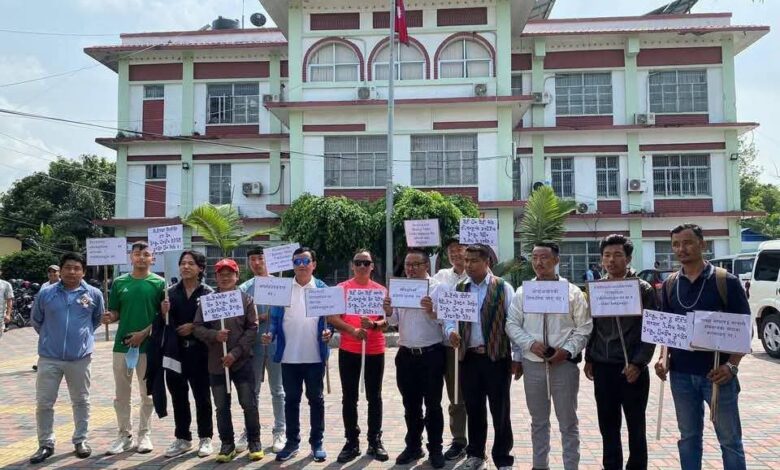
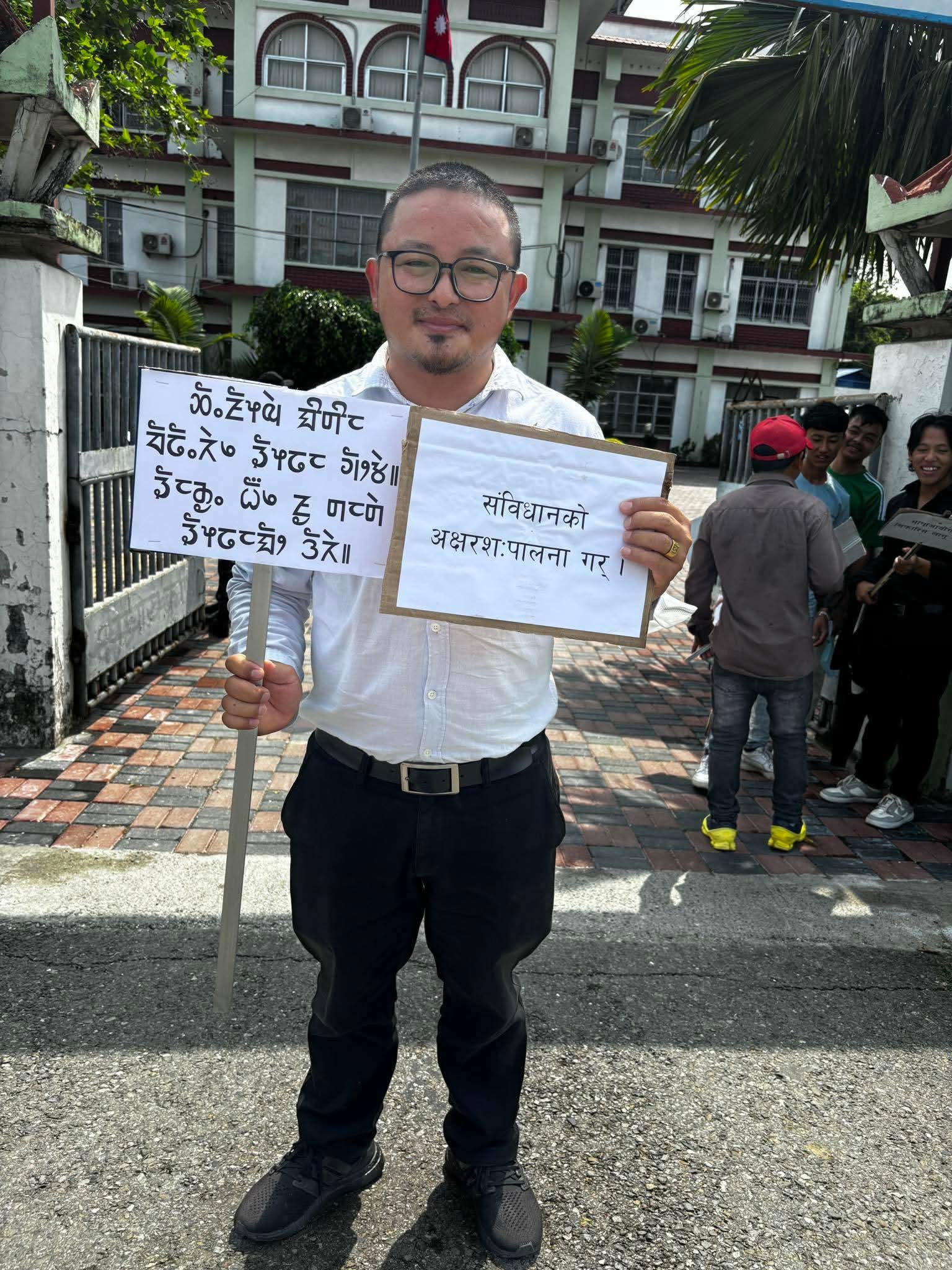
Our first symbolic action was a peaceful sit-in with placards in front of the Office of the Chief Minister. Amit Thebe and Hitram Tilling graciously undertook the responsibility of preparing the placards in Sirijanga script, Nepali, and English, while I arranged for a transportation.
Despite work commitments preventing many journalists and activists from joining, we proceeded with a dedicated team: Mohan Tigela, Amit Thebe, Hitram Tilling, Yobahang Tumbahangphe, Dinesh Tilling, Uday Kurumbang, Prabeg Hangshrong, Alok Hangshrong, Nasal Khajum Chongbang, Dipesh Hukpa Chongbang, Sugam Hukpa Chongbang, Jeevan Prakash Serma, Phipraj Begha, Thangsang Lawati, Rabin Sauden, Nima Pongsuwa, and Sanjita Dhamala.
After submitting our memorandum to the Chief Minister and the Chief Secretary, journalist Sanjita Dhamala skillfully facilitated a peaceful sit-in in front of the Chief Minister’s Office — for which we remain deeply grateful. After completing the programme, we returned to Dharan, while some colleagues headed to Jhapa and Morang.
That was only the beginning.
Thereafter, we repeatedly submitted memorandums and attention letters to the Minister for Law and the Minister for Social Development, as well as to the leaders of the parliamentary parties of every political party. We knocked on every door. We repeated our demand, again and again, with patience and dignity.
During the course of the movement, the Minister for Finance, Honourable Mr. Ram Rana, acknowledging the perception that he was anti-identity, committed himself to advancing the work and even allocated a budget for it. At that moment, we felt our movement had truly found meaning.
Around the same time, Honourable Indra Angbo remarked that perhaps KYC and identity advocates had shown little interest in this modest achievement because they were seeking a larger goal the name of the province itself. Meanwhile, Honourable Khinu Langwa noted that the bill had already been fully prepared during her tenure, but had stalled after she lost her ministerial post.
A healthy competition even emerged between the government and the opposition over who would introduce, table, and claim credit for the bill. For us in the Language Concern Group, however, one principle was clear: whoever accomplishes it, it must result in an achievement for all.
During this period, Province No. 3 had already enacted and gazetted an Act for the Tamang and Newari languages. To learn from that experience, we held repeated Zoom meetings with Amrit Yonjan Sir and others, and moved forward accordingly.
And then, after a long wait, the day arrived.
On the day the Act was finally enacted, Diwali was celebrated across Province 1. It was not just a festival of lights — it was a festival of language, identity, and dignity.
Now that the Act has been passed, the Yakthung Language Implementation Concern Group will continue to serve in the role of a watchdog, closely monitoring how implementation progresses. A law on paper is not enough. It must live in offices, in schools, in signboards, and in the daily life of the people.
We earnestly urge the Provincial Government to form a strong team of experts for implementation, delineate clear clusters, and implement the Act in a manner that ensures the survival and flourishing of all languages.
Finally, I extend my heartfelt gratitude and sincere thanks to the Provincial Government, Honourable Chief Minister Mr. Hikmat Karki, Honourable Province Governor Mr. Parshu Ram Khapung, Honourable Minister Mrs. Khinu Langwa, the Provincial Assembly, all Honourable Members, and particularly those Honourable Members who played a leading role Mr. Indra Angbo, Mrs. Nirmala Tawa, Mr. Kishor Chandra Dulal, Mr. Ramesh Basnet, Ms. Mina Shrestha, Mr. Bidur Lingthep, Mr. Rajendra Rai, Mr. Bijaya Rai, and others.
I also extend my collective thanks and congratulations to the pioneering activists who came before us, to all campaign workers who supported this movement, and to the journalists who disseminated our news to the people.
We remain hopeful that all Honourable Members will continue to play a strong role in the implementation of these languages and will continue to encourage and hold the government accountable.
The Act is passed. The struggle is not over. The journey of implementation has just begun.
(Writer Tigela is associated with Yakthung Language Implementation Concerned Group)


